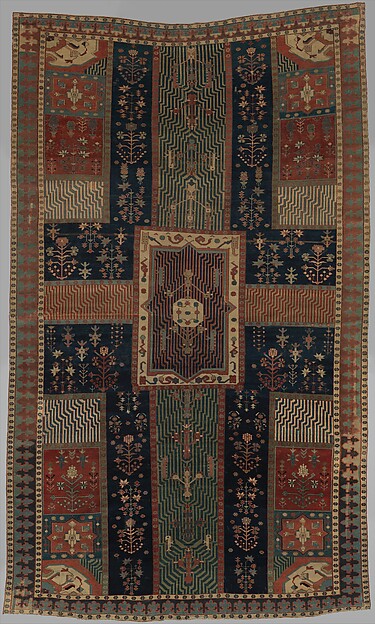
The museum says India or Iran. The flowers refuse to choose.
A productive uncertainty
A fragment of silk and metal-wrapped thread, dated approximately 1628–58, carries interlocked tulips and poppies. The Met describes its place of origin as India or Iran. The attribution is not a defect to hide. It is a reminder that motifs and skills do not respect the boundaries we draw on maps.
We cannot solve a textile's history merely by deciding which national collection we would prefer it to belong to.
The grammar of repetition
Look at how the floral forms interlock. Repetition is not a lack of invention. It is a discipline of variation, a way to make a surface sustain itself beyond one isolated motif.
The fragment does not give us the complete garment or interior it once belonged to. It gives us something nearly as interesting: the intelligence of a pattern that has outlived its first use.
Interlocked Tulips and Poppies
Maker unknown · c. 1628–58
Silk and metal-wrapped thread · India or Iran
The Metropolitan Museum of Art