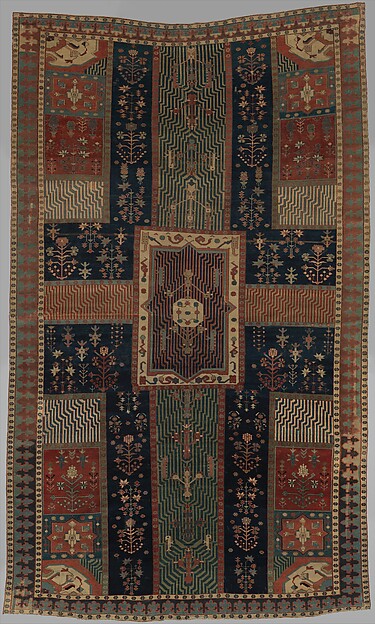
The Emperor’s Carpet is larger than most rooms. Its history has somehow made the people who created it smaller.
The scale of it
More than seven metres of densely woven landscape: animals, blossoms and sweeping vines. This is a world assembled without a horizon. The eye cannot settle for long before another creature interrupts.
The Metropolitan Museum records the carpet as a work of Safavid Iran, made in the second half of the sixteenth century. Its extraordinary detail was never intended to be taken in at a glance. Look at the central field, then the border. A different rhythm takes over.
Whose names survive?
The carpet later entered a Habsburg residence in Europe. Its journey was sufficiently important to be traced. The makers who knotted its astonishing surface are not named.
It is tempting to call the work anonymous. That word is convenient for the archive but inadequate for the object. Anonymity is a condition of the surviving record, not evidence that its creators lacked identities.
Look again
To examine the carpet is to move between a collective achievement and a single monumental thing. The museum has preserved the latter. The former remains more difficult to recover.
Perhaps its greatest act of resistance is simple: the longer we look, the harder it becomes to believe that an object of this intricacy made itself.
The Emperor’s Carpet
Unidentified Safavid weavers · Second half of the 16th century
Woven carpet · Iran
The Metropolitan Museum of Art